Earths Orbit Varies From Nearly a Circle to an Ellipse and Back Again in About
World'southward climate is e'er-changing. At least several times in the past, a layer of ice has smothered much if not all of the planet's surface — including its seas. The most recent time such a "Snowball Earth" existed was about 635 million years ago. At other times, global temperatures have soared then high that little if any ice remained anywhere, even nigh the poles. (A brief one of these and then-called Hothouse Globe episodes adult nigh 56 million years ago.)

More often than not, when levels of these gases fall, so do temperatures across the globe. (At that place are exceptions, however. The gradual erosion of mountains can trigger chemical reactions that can remove carbon dioxide from the air. That, also, can trigger a long-term cooling.)
But those are the extremes. Starting most 2.six million years ago, Earth experienced a number of ice ages. Those cool spells — mayhap 40 or more than of them — didn't cause the entire planet to freeze, as likely happened in Snowball Earth eras. Just these extra-cool periods did trigger the formation of big, thick sheets of ice in some parts of the Chill. The largest and thickest ice sheets were centered over eastern Canada. But during the peaks of some ice ages, the ice spilled south into what is now the United states. The virtually recent water ice age ended nearly 12,000 years ago.
In North America, the last four ice-historic period cycles lasted nearly 100,000 years each. That includes a roughly 10,000-year warm spell between each ice age. So, the ice ages themselves lasted, on average, about 90,000 years. During each common cold spell, the ice canvass gradually grew to large size. So it retreated of a sudden and disappeared.

For a long while, scientists wondered what caused this pattern. So a Serbian scientist named Milutin Milanković (Mih-LAN-koh-VITCH) noted that the pattern appeared tied to long-term changes in Earth's orbit effectually the sun. Scientists at present recognize orbital features can play a major role in long-term shifts in climate.
Changing orbits and tilts
Earth's orbit is largely stable (thankfully!). Yet there are minor changes in certain aspects of Earth and its orbit that vary in predictable means, Milanković noted. Importantly, all of these changes touch on the strength of sunlight reaching World's surface.
Ane attribute of the orbit is its eccentricity (Ek-sin-TRISS-ih-tee), or roundness. At times, the planet'southward orbit is well-nigh perfectly circular. At others, its path around the sun becomes more similar a slightly squished oval. When the orbit is its nearly squished, Earth'due south distance from the lord's day at its farthest is about 3 percent further than when information technology is at its closest bespeak for the year.
That might not seem similar a lot, merely information technology means that the sunlight falling on the planet is about 6 percent stronger in some seasons than in others. More than sunlight volition contribute to greater warmth. It takes nigh 100,000 years for Globe's orbit to vary from nearly-round to squished and and then dorsum again to near-circular. This change stems, in large part, from the gravitational tuggings exerted on Earth by Jupiter and Saturn, the largest planets in our solar arrangement.

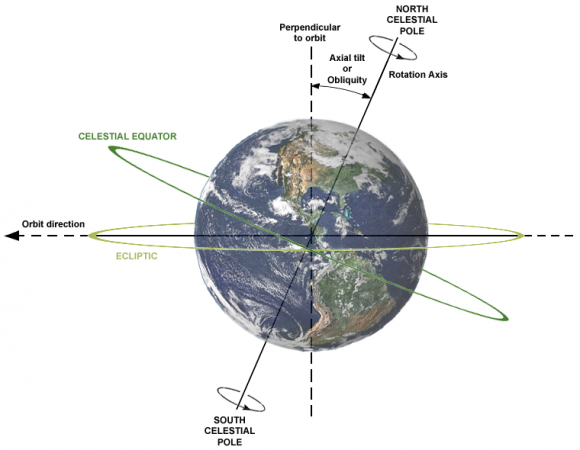
Another slowly varying aspect of Earth's orbit is the tilt of the planet's axis. Right now, the line that runs through World's north and south poles is tilted well-nigh 23.5° from the management that our planet travels around the lord's day. This tilt, known as obliquity [Oh-BLIK-wih-tee], gives Earth its seasons.
For instance, when the North Pole is generally pointed toward the sun, the Northern Hemisphere receives sunlight more directly and experiences warmer months. It takes nearly 41,000 years for Earth'due south axis to shift from a tilt of 22.1° to 24.v° and and then dorsum again. When the axial tilt is at the low stop of its range, Earth'southward seasons are more than even. Summers aren't too hot; winters don't become as common cold. But when the tilt is higher than average, the temperature shifts between summertime and winter get more extreme.
Finally, World slowly wobbles as it rotates. Right now, our planet'south Due north Pole constantly points toward a spot near a star named Polaris. (That'southward why this star is also commonly known as the North Star. Hikers and send captains in the Northern Hemisphere often apply Polaris to assistance them navigate, because information technology always sits in the same spot in the dark sky.) But considering Earth isn't a perfect sphere and its axis is tilted, the gravitational pulls of the lord's day and moon crusade Earth'due south axis to wobble. (The move, called precession, is similar to a spinning summit wobbling on a tabletop as it slows down.) It takes about 26,000 years for Earth to consummate one wobble.
These three cycles — of eccentricity, obliquity and precession — take different lengths. In some instances they line up. Most of the fourth dimension, they do not. (Like waves on a swimming or the ocean, sometimes the planet-warming effects of these cycles stack upward and reinforce each other. At other times, they may tend to cancel each other out.) For the Northern Hemisphere's ice sheets, the biggest factor affecting their growth is the amount of summertime sunlight in the Chill, scientists say. When the summertime sun is relatively weak, some of the snow that brutal in the previous winter may not melt. And then slowly, twelvemonth by year, snow starts to build up. In time, an ice sheet will amass that grows thicker and spreads farther.
Later on an ice sheet develops . . .
Once ice sheets start to grow, some other factor kicks in. It also will assist snow accrue. We're referring to the corporeality of sunlight that the ground reflects back into space. Scientists call this Earth'south albedo. White surfaces reverberate more sunlight — a source of heat — than exercise dark surfaces. And so an ice sheet volition tend to stay cooler than volition bare rocks and soil. Snow and water ice also last longer when temperatures are cooler. That means that in one case ice sheets start to abound, they assistance themselves abound even more.
This ability of ane factor to reinforce another is chosen a feedback. And here, the buildup of snow whitens the ground — increasing its albedo. This, in turn, reflects more of the sunlight that might otherwise have fostered melting.
Together, eccentricity, obliquity and precession join to make ane cycle that lasts nigh 100,000 years. That roughly matches the length of contempo water ice-age cycles in N America, scientists have noted. But that match did not explicate why water ice ages start gradually merely finish of a sudden.
In 2013, some researchers offered a possible caption. They used computers to predict the warming from sunlight that falls on Chill regions. They likewise included a 2d factor, the effect of a gradually growing ice canvas on Earth'south chaff.
Explaining abrupt ends
When an water ice canvas commencement starts to grow, information technology doesn't counterbalance much. Merely an ice sail 3 kilometers (almost 2 miles) thick will exist crushingly heavy. In fact, information technology causes World'due south crust to sag down about 1 kilometer (around 0.half-dozen mile). Fifty-fifty though the sagging volition be largest beneath the center of the ice sheet, the edges, too, volition dip to lower altitudes. And that has a very important effect: Because temperatures at lower altitudes are warmer than those higher up, the heavier an ice sheet becomes, the more likely it is to melt effectually the edges.
Once all three of the orbital cycles team up to provide maximum warmth, an ice canvass will melt away. Indeed, it will disappear before Earth'due south crust tin can spring back upwardly to cool and save information technology.
Later, after Earth's chaff has risen back close to its normal level and the three orbital cycles gradually motion out of sync, Northern Hemisphere summers cool off a fleck and water ice sheets again can begin to grow. The researchers reported their findings in the Baronial 8, 2013, Nature.
That's one possible explanation for the gradual growth and sudden demise of ice sheets, scientists say. Here'due south some other possibility: A thicker ice sail more than effectively traps heat coming upward to the surface from Earth'due south interior. That, in turn, helps melt water ice at the bottom of an ice sheet. That melting then helps the ice canvas menstruation like a glacier, become thin at the edges and melt back even more than.
Other factors surely play roles in the growth and demise of water ice sheets. For instance, ice sheets typically trigger changes in weather patterns across broad regions, scientists accept shown. Some areas don't become as much rainfall as before. This makes them dry out up and produce lots of dust. If that dust gets swept up into the air and later falls on the water ice canvass, it volition darken the ice. That ice will now absorb more sunlight. This will make it cook more than quickly than if it were clean. (There's the albedo issue once more!)
Finally, how much carbon dioxide exists in Globe's atmosphere can affect temperatures almost the surface. Correct now, the average global concentration of that planet-warming gas is most 400 parts per million (it was 396 ppm in 2013). It had ranged only between 180 and 280 ppm for the terminal 400,000 years. But then people began calculation large amounts of carbon dioxide to the atmosphere, starting in the 1700s, with the beginning of the Industrial Revolution.
According to Earth's orbital cycles, our planet might exist overdue for the adjacent ice age. But with so much carbon dioxide now in the atmosphere, that ice age might not arrive for a very long time — if it comes at all.

Source: https://www.sciencenewsforstudents.org/article/explainer-understanding-ice-ages
0 Response to "Earths Orbit Varies From Nearly a Circle to an Ellipse and Back Again in About"
Post a Comment