What Impact Did Islamic Religion Have on Art and Architecture
Islamic art is the term used to describe the broader fine art forms that occurred in Islam subsequently the 7th century CE. It was non restricted to only Muslim artists making religious artworks, but all art forms and non-Muslim artists nether this designating term. This article will explore Islam art, its characteristics, likewise as some of the common art forms from this all-encompassing artistic and cultural period in the Islamic world.
Tabular array of Contents
- ane Introducing Islam: A Chronological Overview
- 1.i Early Period
- 1.ii Medieval Period
- i.3 Later Period
- ii What Is Islamic Art?
- 2.1 Islamic Art Characteristics
- ii.2 Islamic Calligraphy Art
- two.iii Islamic Architecture
- two.4 Other Islamic Fine art Forms
- 3 Islamic Art: From the Past to the Present
- 4 Frequently Asked Questions
- 4.i What Is Islamic Art?
- iv.2 What Are the Characteristics of Islamic Art?
- four.3 When Did Islamic Art Occur?
Introducing Islam: A Chronological Overview
It was only during the 19thursday century CE when the "umbrella" term, Islamic fine art, was used to describe the cultural material from the vast regions of Islam, spanning near 1400 years. Therefore, it is of import that when we explore Islam fine art, nosotros must keep in mind that it includes numerous art forms and artists from numerous regions and socio-political structures similar kingdoms and dynasties.
To sympathize Islam art, let u.s. briefly explore how it originated, and what the Islamic faith is.
The Islamic religion is one of the world's largest practiced monotheistic religions aslope Christianity and Judaism (all of which are also called "Abrahamic faiths" because they share similar relationships with the prophet Abraham).
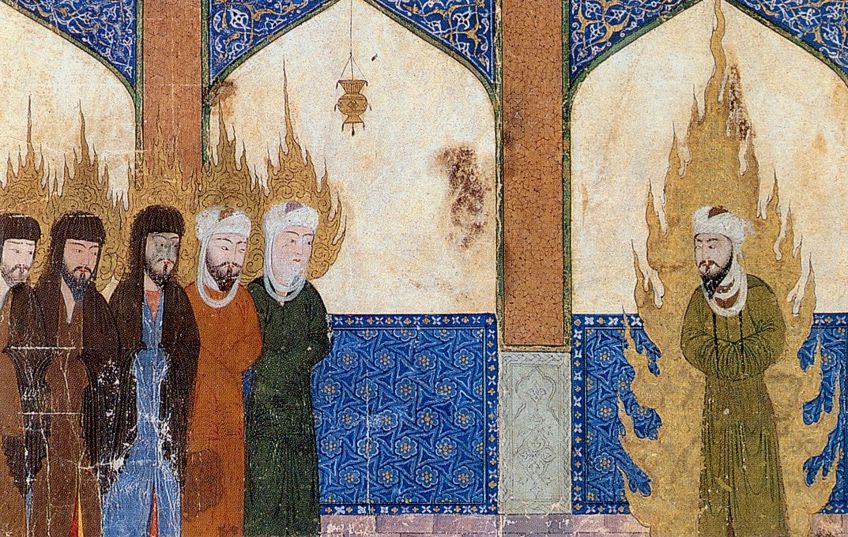 Medieval Western farsi manuscript depicting Muhammad leading Abraham, Moses, and Jesus in prayer;Unknown author Unknown writer, Public domain, via Wikimedia Eatables
The beginnings of the Islamic religion prevarication with the prophet Muhammad, who was the founder of the religion, and its seminal religious text, the Qur'an, which was written from the prophet's recitations subsequently his religious revelations. The Arabian city, Mecca, is where Mohammad is believed to take been born, and is considered a sacred and holy metropolis.
Islamic art can be divided into iii chronological time periods for easier understanding and context. This includes the Early on flow, from effectually 640 to 900 CE, the Medieval menses, from around 900 to 1517 CE, and the final, or Later period, which was from effectually 1517 to 1924 CE.
Below, we look at each fourth dimension period and the prevailing dynasties and other ruling structures within each.
Early Period
The Early menstruum in Islam's socio-political history and art is estimated to be around 640 to 900 CE. This falls just later Mohammad'south decease, which was in the year 632 CE. After Mohammad's death, four Caliphs were appointed equally his successors, known every bit the "Rightly Guided Caliphs" – Caliphs are rulers within what is known as the caliphate, which is a state nether Islamic rule.
The word "caliph" originates from the Arabic word "Khalifa", which means "successor".
These four Caliphs include the offset, Abu Bakr, who ruled from 632 to 634 CE; Omar (or Umar), who reigned from 634 to 644 CE; Uthman ibn Affan, who reigned from 644 to 656 CE; and Ali ibn Abi Talib, who reigned from 656 to 661 CE. In that location was a fifth Caliph, Al-Hasan ibn Ali ibn Abi Talib, simply he reigned only for a few months and is not as prominent every bit the abovementioned 4.
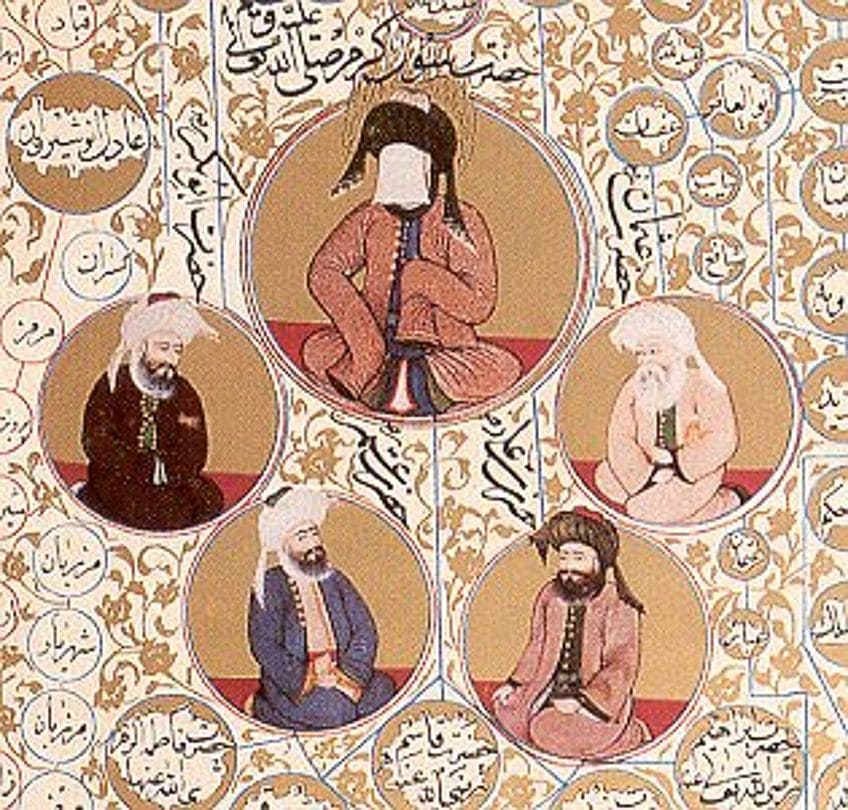 Mohammed (top, veiled) and the first four Caliphs, from the Subhat al-Akhbar;Unknown author Unknown writer, Public domain, via Wikimedia Commons
During this period, there was political unrest over the successors, and Uthman ibn Affan and Ali ibn Abi Talib were assassinated by rebels and sects who protested for new Caliphs. This is when the outset civil war (oftentimes also known as the "First Fitna") started, which occurred while Ali ibn Abi Talib reigned. After his assassination, the Umayyad Dynasty started, based in Damascus, Syria.
This was also when the fifth caliph, Al-Hasan ibn Ali ibn Abi Talib, signed a peace treaty for the caliph Mu'awiya to rule. The Umayyad Dynasty ruled from around 661 to 750 CE, and the second civil war ("Second Fitna") started after Mu'awiya's expiry in the year 780 CE.
The Abbasid Dynasty ruled later the Umayyad Dynasty.
This new dynasty was founded by Abbas ibn Abdul-Muttalib after the Abbasid Revolution in 750 CE. The Abbasid Dynasty ruled in Baghdad, which was founded by Al-Mansur, the second Abbasid Caliph (this was afterwards they ruled in Kufa, Republic of iraq). Eventually, the dynasty was taken over in 1258 CE by the Mongol Empire.
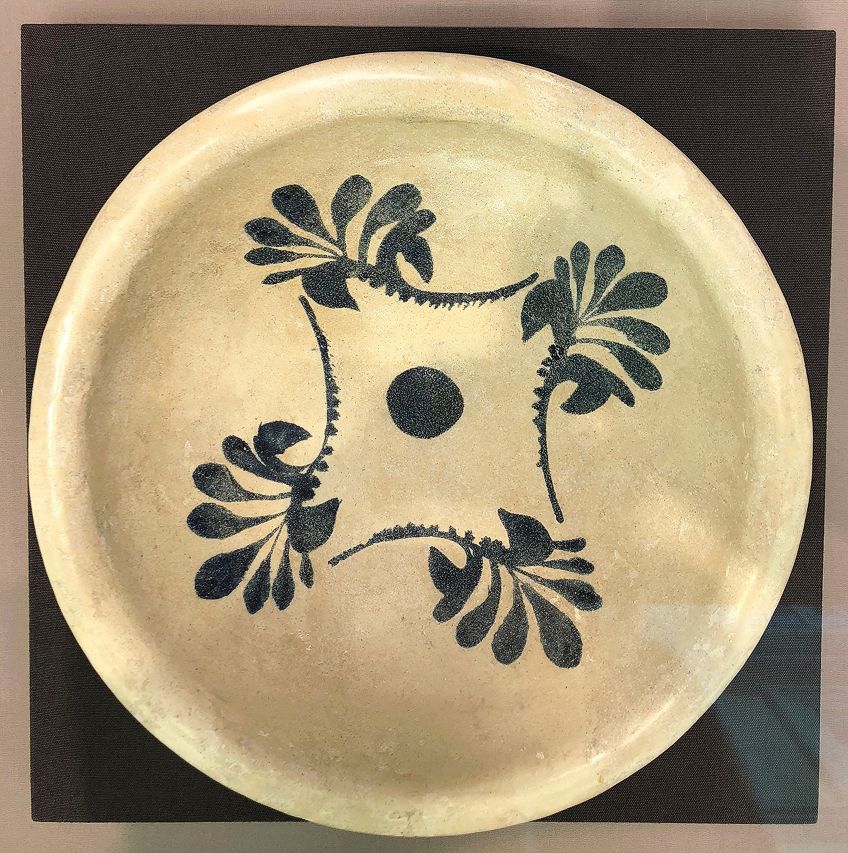 Abbasid 9th-century stoneware, probably from the 830s, from a Tang shipwreck of that decade;Bjoertvedt, CC By-SA iv.0, via Wikimedia Commons
The Abbasid Dynasty was also known as the "Islamic Golden Age" as it became a cultural and intellectual heart in various disciplines like scientific discipline, technology, theology, literature, visual arts, music, amid others. There was also a cantankerous-cultural influence between the East (such as China, India, Iran) and the West (for instance, Europe'due south Byzantine and Classical Antiquity styles).
This is also where Islamic art began to flourish, creating pottery, ceramics (specially what is known by luster-ware), wood, stone, textiles, and various other artistic modalities. The fine art during this period also contributed to how Islam art would eventually develop over time.
Medieval Period
The Medieval menses started around the 900s CE and lasted until nigh the 1500s CE. As the Abbasid Dynasty ended, there were several new dynasties in North Africa and the E. This started with the Fatimid Dynasty, which began around 909 to 1171 CE. The Fatimids Mohammad's daughter's name, which was Fatima.
During this period, the Fatimids ruled in Arab republic of egypt and Syria, with Cairo equally the main city.
This too became a cultural eye with a trade route in the Mediterranean and the Indian oceans. There was likewise a focus on building architectural structures like Mosques, which were important religious structures. Some prominent examples include the Al-Hakim and Al-Azhar Mosques in Cairo.
Other forms of art that emerged from the Fatimid Dynasty included ceramics and pottery, relief sculptures, and carvings made from ivory. There was also a focus on decorative patterns on objects, such every bit leafage (otherwise referred to as "vegetal" forms) and human being shapes. The Fatimid Dynasty produced its art in a luxurious fashion.
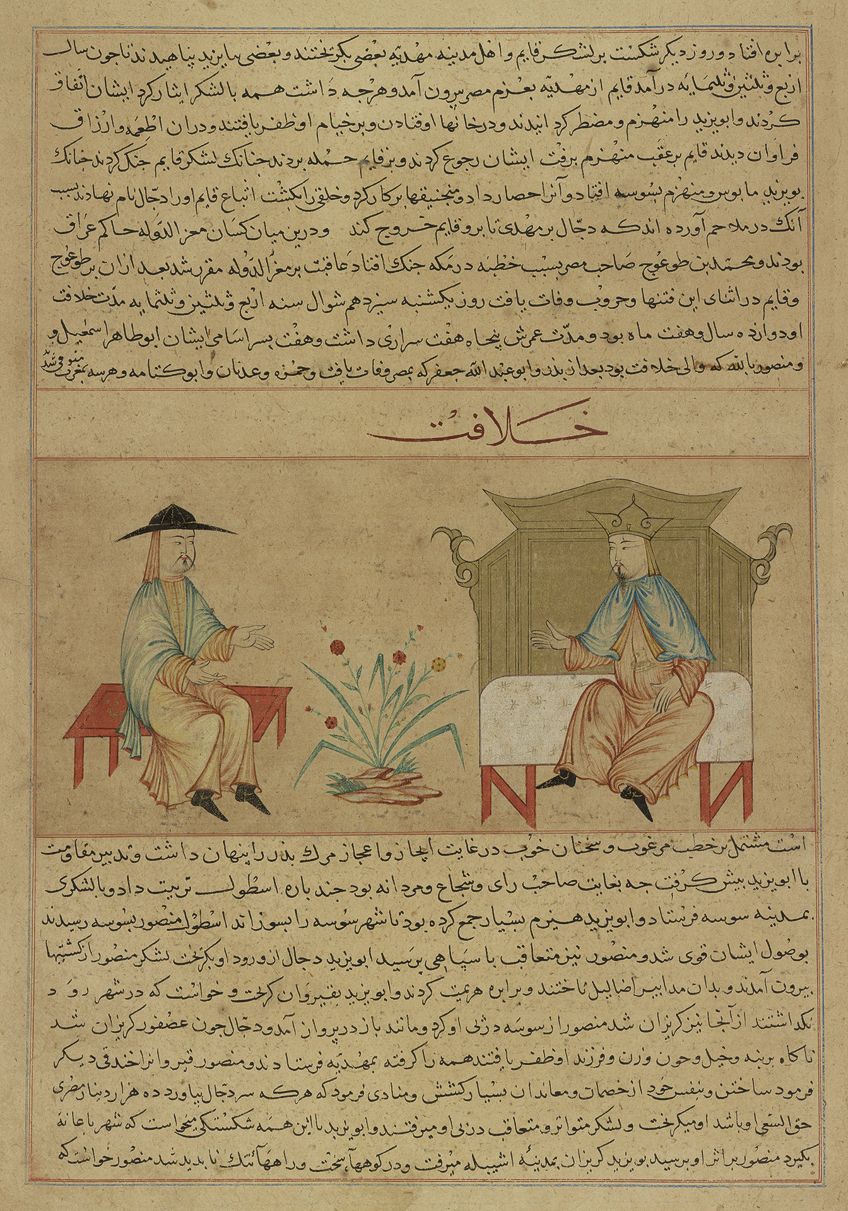 Mansur, Fatimid Caliph of Arab republic of egypt, from a manuscript of Hafiz-i Abru's Majma' al-tawarikh (c. 1425);Yale University Fine art Gallery, Public domain, via Wikimedia Eatables
After the Fatimid Dynasty came the Ayyubids, who reigned from 1171 to 1250. Other dynasties included the Ghaznavids, who ruled from 977 to 1186 CE, who were Turkish in origin. The Seljuk Empire, also Turkish, ruled around the years 1038 to 1194 CE. The Seljuks consisted of a stiff military force and ruled in areas similar Iran, Iraq, Syria, and Turkey.
The Seljuks made significant contributions to the development of culture, art, and politics. They besides invested in the evolution of education through schools, called "madrasas" in Arabic.
Some of the more notable architectural inclusions from this menses include the four-iwan layout for congregational mosques, consisting of four doorways on each side of a rectangular building or courtyard. A famous example of such a building is the Masjid-e Jameh, or the Great Mosque of Isfahan, which was built by the Malik Shah. Other artistic developments included ceramics, metalwork, textiles, and more. Some of the techniques in ceramics included fritware.
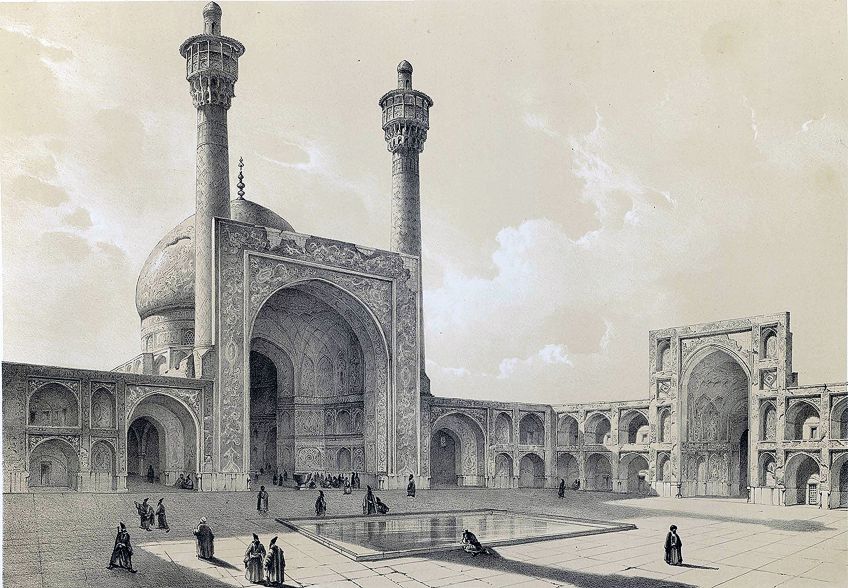 A drawing of the courtyard of the Jama Mosque, Isfahan by Eugène Flandin, 1840;Eugène Flandin, Public domain, via Wikimedia Eatables
The Mamluks reigned from effectually 1250 to 1517 CE and were mainly based in Cairo, Egypt, Syria, and other areas in the Centre East. The Mamluks were freed slaves or slave soldiers from various cultures, specially Turkic slaves. The Arabic give-and-take mamluks means "endemic" or "ane who is owned".
During the Mamluk rule, there was besides a surge in Islamic art and architecture, specially with the intention to emphasize the grandiosity of the rulers. Cairo was ane of the cultural and artistic centers at the time and showcased the rich and elaborate expressions of Muslim fine art. Buildings included mosques, schools, and mausoleums, amidst others.
Other forms of art and craft included metalwork and glasswork.
Ceramics besides showed influence from Eastern cultures like the Chinese due to the extensive trade routes, which allowed a wider reach. An instance of elaborate adroitness is the metal basin, Baptistere de Saint Louis (1290 to 1310).
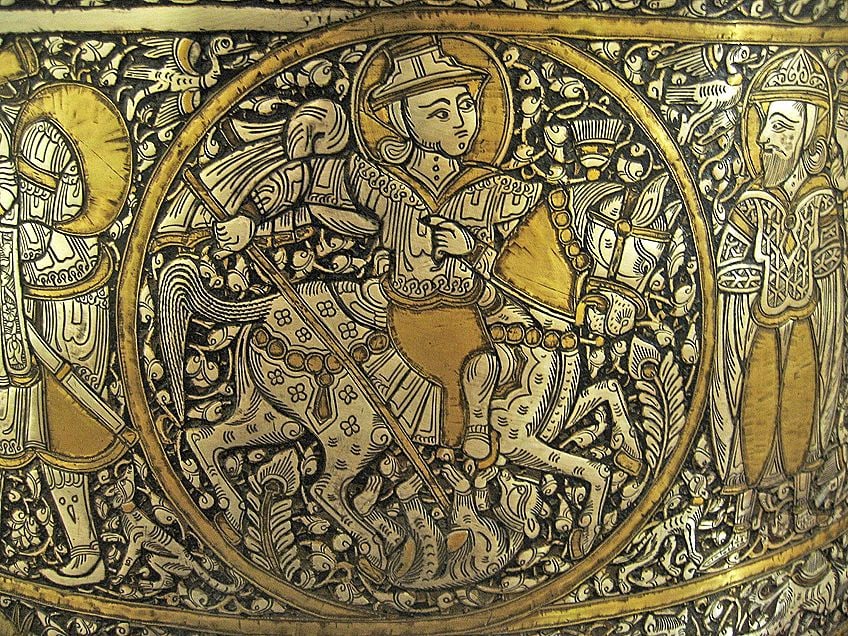 Baptistère de saint Louis (between c. 1320 and c. 1340) past Mohammed ibn al-Zain. Basin with a procession of officials and four riders in roundels (exterior band) and friezes of animals and coats-of-arms (interior ring); Louvre Museum, Public domain, via Wikimedia Commons
Afterwards Period
The Ottomans started to overrule the Mamluks, reigning from around 1281 to 1924. This introduces the Later period in Islamic history, as well as Islamic art and compages, amidst other arts and crafts. The Later on period includes several important dynasties and empires, notably the Ottoman Empire; the Timurids, who reigned from around 1369 to 1502; the Safavids, who reigned from effectually 1502 to 1736; and the Mughals, who reigned from around 1526 to 1858.
The Ottomans took control over the Byzantine empire'due south city, Constantinople, in 1453, which then became Istanbul. With their rule, they introduced impressive architectural structures. Architects also utilized the Byzantine-style dome in building layouts. Other forms of Muslim fine art included ceramics and decorative arts, specially the Iznik pottery style.
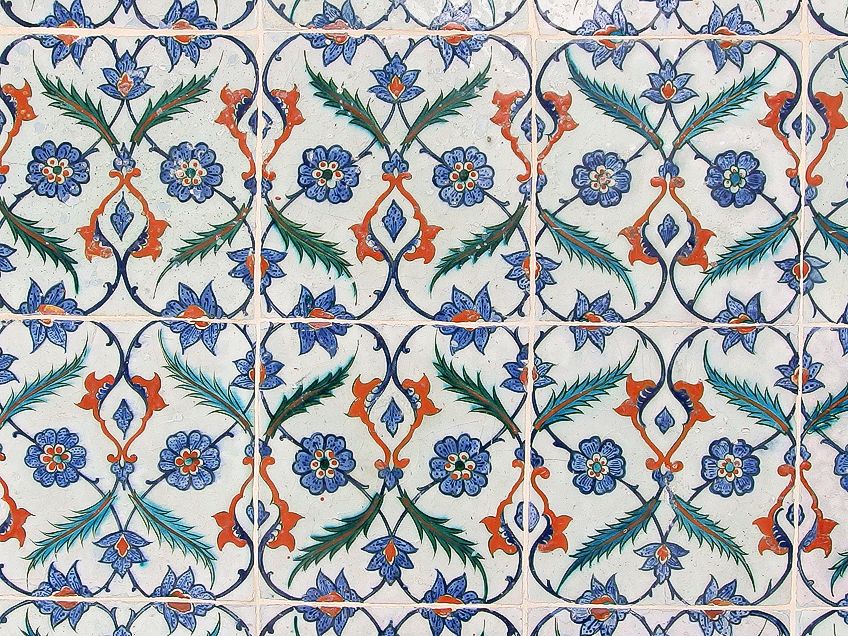 Ceramic tiles in the Iznik style, Topkapı Palace, 18th century;Mark Ahsmann, CC By-SA 3.0, via Wikimedia Commons
The Iznik style was prominent on tiles and was characterized by flowers and vines in curvilinear shapes. The colors consisted of different hues of blues and turquoise. There was also an extensive production of textiles as well as the all-encompassing employ of calligraphy, which was an important role of Islam fine art. Some prominent examples include the Topkapı Palace (construction started in 1459) and the Süleymaniye Mosque (1550 to 1558).
When nosotros await at the Timurids and Safavids, both empires included impressive architectural structures.
The Timurids adult elaborately busy buildings, many examples of which tin be found in the city Samarkand, which became the uppercase city under Timur's rule. He further expanded this city with the assist of numerous artists, architects, and craftsmen. The main objective was to brand it a "pearl of the earth", glistening with colors similar golds and hues of blue.
The Safavids besides produced high-quality manuscripts, specially illuminated manuscripts. Islamic painting through this form of art was exceedingly popular, and a pregnant number of patrons came from the royal court. An case tin be seen in the Shahnama, which was a "Book of Kings".
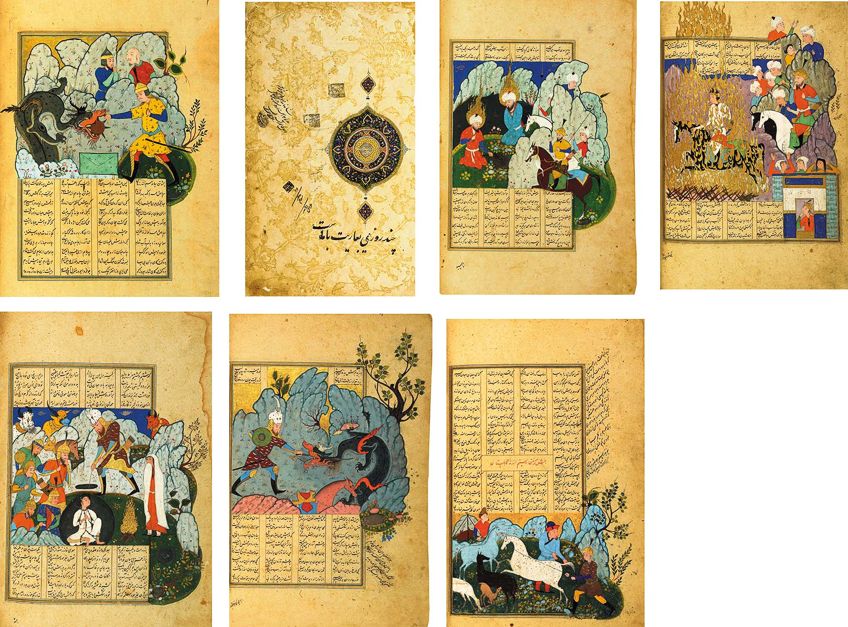 Pages from an illustrated manuscript of the Shah Namah that may accept belonged to Jahangir, c. 1570;Run into page for author, Public domain, via Wikimedia Commons
Other forms of art included textiles, especially in the grade of Farsi carpets, which were utilized in the courts, such every bit theArdabil Carpet (1539 to 1540). The entire carpet appears elaborately decorated with forms of foliage, flowers, and other patterns.
The Mughal Empire was founded by the chieftain Babur, who was a descendent of Timur and Genghis Khan, the starting time emperor of the Mongol Empire.
The Mughal Empire extended its attain into Bharat. Artwork spanned across painting, architecture, illuminated manuscripts, and more. This catamenia as well includes the construction of famous building, the Taj Mahal (1632 to 1653), commissioned to be congenital by Shah Jahan, who was the fifth Mughal Emperor.
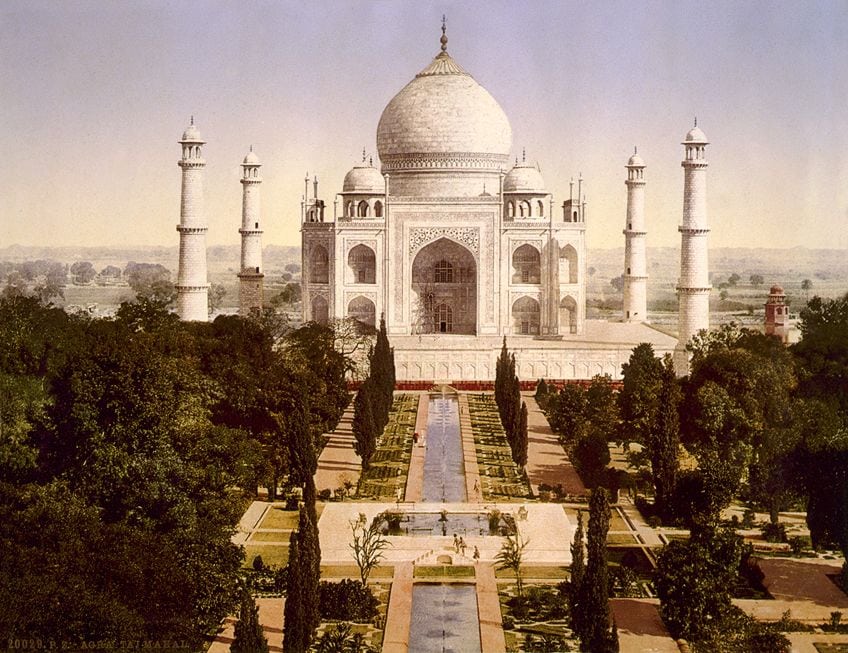 A photograph of the Taj Mahal, Agra, Republic of india, c. 1900;Detroit Publishing Co., under license from Photoglob Zürich, Public domain, via Wikimedia Commons
What Is Islamic Art?
While there were numerous Islamic dynasties and empires throughout Islamic history, the art of each period evolved and developed according to individual regions also as the overlapping of these different ruling dynasties and empires. Below, nosotros look at some of the common Islamic art characteristics and the prevalent themes recurring throughout.
Nosotros will look at various Islam fine art modalities like painting, compages, the importance of Islam calligraphy fine art, and more.
Islamic Art Characteristics
Islamic art and architecture tend to exist characterized by the shared commonality that is the Islamic organized religion. The veneration of the Islamic organized religion and its traditions underpin almost all of Islam fine art with the main holy text, the Qur'an, serving every bit a guidepost for Muslim artists. So, with that in listen, when we look at Islam fine art, we can empathize what drove and inspired Muslim artists to create their works.
Information technology is too important to note the dissimilar religious practices within the Islam faith, as these also had a place within many buildings and objects used to facilitate religious expression.
 The Five Pillars of Islam;Xxedcxx, CC Past 3.0, via Wikimedia Commons
These buildings and objects at present fall nether the scope of Islamic art and architecture. Some of the Islamic practices include the important "Five Pillars of Islam" (or Arkān). These are, namely, the Shahada (Profession of Faith), the Salah (Prayer), Zakat (Almsgiving), Sawm (Fasting), and the final, Hajj (Pilgrimage).
Practitioners of the Islamic faith were required to adhere to these practices. The get-go do, for example, the Shahada, involves the core belief or tenet that "there is no god just God, and Muhammad is the Messenger of God." This is also widely seen inscribed in Islamic art and compages.
This likewise emphasized the close link between the art form and the proclamation of one's religious beliefs. Islamic art like paintings and architecture acted as vehicles for religious and sacred expressions, which then begs the question of whether the label equally "fine art" simply came afterward through fine art historical inquiry.
Arabesques
Other characteristics include the highly busy patterns and Islamic motifs, including geometric and floral shapes done in various patterns. The geometric Islamic motifs hold significant symbolism related to God and transcending life, symbolizing the infinite.
These geometric patterns are as well referred to every bit Arabesques and are seen far and wide on many buildings.
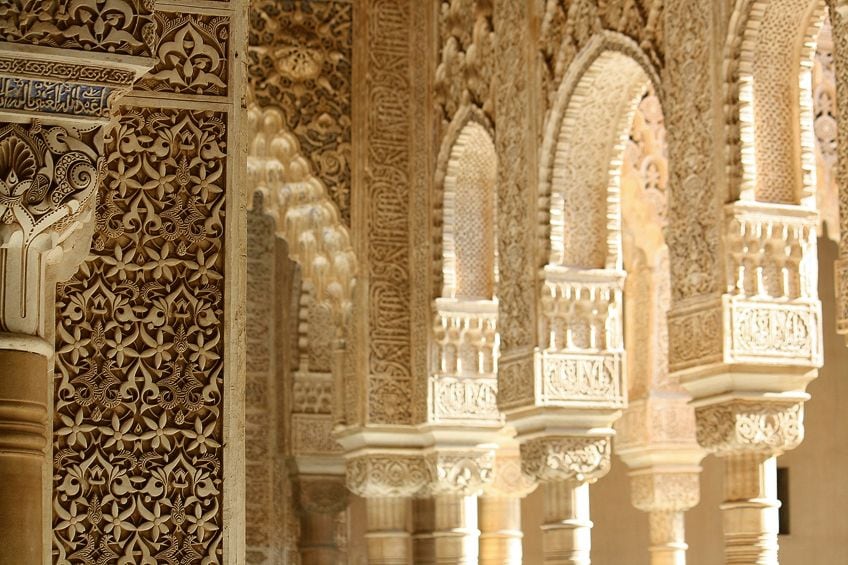 The Arabesque walls and architecture of the Alhambra;FrDr, CC Past-SA 4.0, via Wikimedia Eatables
Some examples can be seen as far equally Spain, like the Alhambra (c. 1238 to 1358), which means "The Red One" in Arabic) as well as many more notable buildings. There were likewise three primary types of buildings built, namely: mosques, madrasas (religiously oriented schools), and mausoleums. All of these buildings would exist built and decorated in varying ways.
Another Islamic art characteristic is that only geometric and floral patterns were utilized with no inclusion or portrayal of the human being figure and animals. The human figures were considered idol worship and non considered suitable for depictions in Islam art, which were meant for worshipping purposes.
This is referred to as Aniconism and falls under the Islamic law called Sharia Law. In some forms of Islam art, at that place would be depictions of holy figures like Mohammad and others as function of telling a story, although the use of more than geometric and floral shapes as well calligraphy was more prevalent.
While Aniconism was a stiff part of Islamic art and compages, there are examples where this was non practical.
While the older, more religious spaces subscribed to aniconism, such equally the shrine in Jerusalem called the Dome of the Rock (c. viith century CE) and the Al-Aqsa Mosque (completed in 705 CE), other spaces that belonged to sovereigns and their individual homes chose to include humans and beast figures. Examples of these include the palace called Khirbat Mafjar (c. 8th century CE), also known as Hishām's Palace.
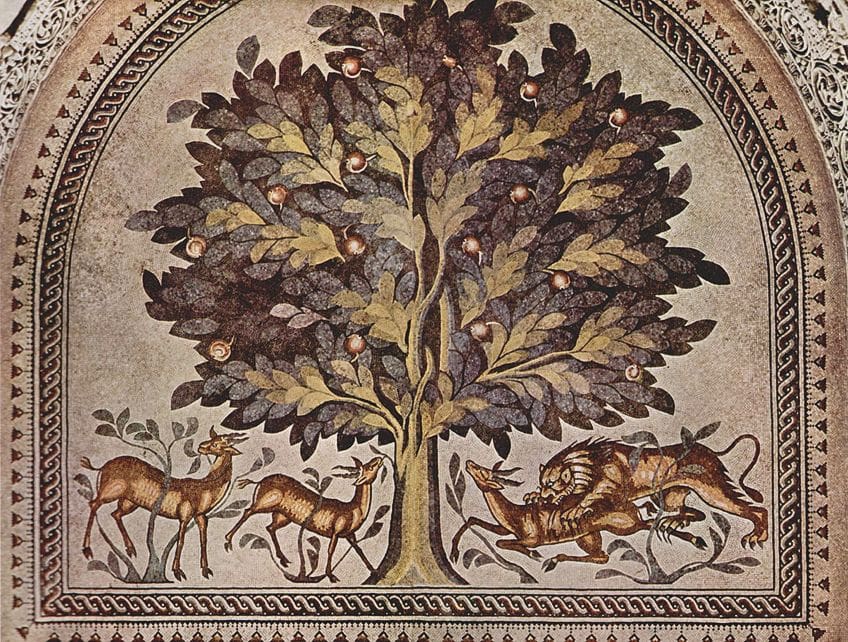 Floor mosaic of the audience room in the bathhouse of Khirbat al-Mafjar, Jordan, 724-743. The scene depicts an apple tree tree with gazelles and lion;Arabischer Mosaizist um 735, Public domain, via Wikimedia Eatables
Other examples include the castle Qasr Amra (too called Qusayr 'Amra), which is in Jordan. It houses various frescoes on the walls depicting a variety of scenes like hunting, women, and some animals. There are also other forms of Islam fine art that portrayed figural depictions, seen on textiles, ceramics, metalwork, and illuminated manuscripts.
Calligraphy
Islam fine art would non exist complete without mentioning calligraphy. As mentioned before, calligraphy played a major role in Islam art and architecture, too as other forms of Muslim fine art. Calligraphy was the vehicle through which Muslim artists venerated the written word and messages given by Mohammad in the Qur'an.
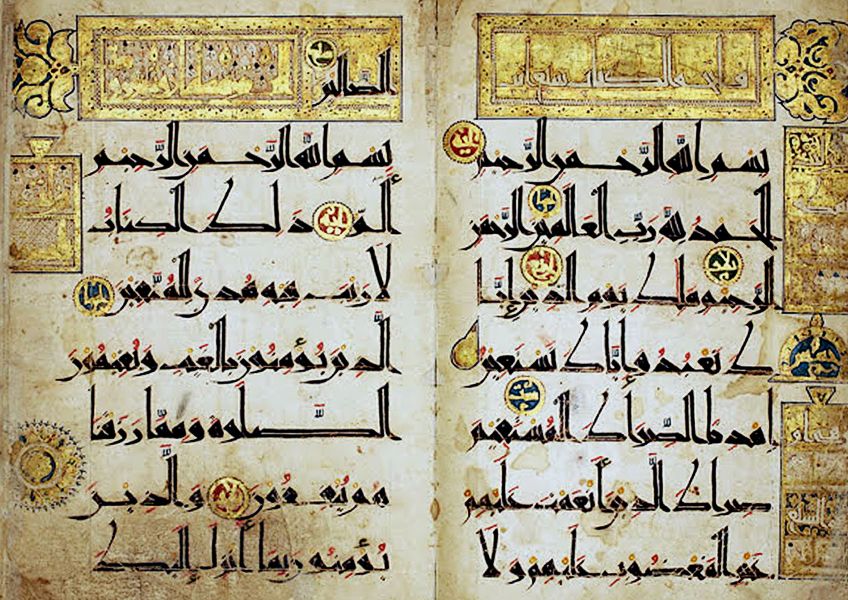 Handwritten Qur'an in Kufic script, from Iran, dating to the after 11th century CE. According to Islamic-Arts.org, "This fragment contains the surah al-Fatihah (the Opening), and al-Baqarah (the Moo-cow). The script is remarkable for its size, each line being roughly four cm high";Unknown Islamic calligrapher of Iran, afterwards 11th century CE, Public domain, via Wikimedia Commons
Where in Christianity at that place was strong visual imagery of religious icons, Muslim fine art veered more than towards the written word being painted on surfaces. This served two purposes: to decorate the surface every bit well as convey the important religious messages from the Qur'an.
Beauty and Meaning
When nosotros look at Islam art, we will discover a significant focus on ornament and lustrous colors similar blues and golds. These colors and designs were besides used in common household items like bowls, jewelry, and furniture. Islam art was about a way of life – objects were highly decorated, non simply for the mere sake of art, merely also for a deeper meaning.
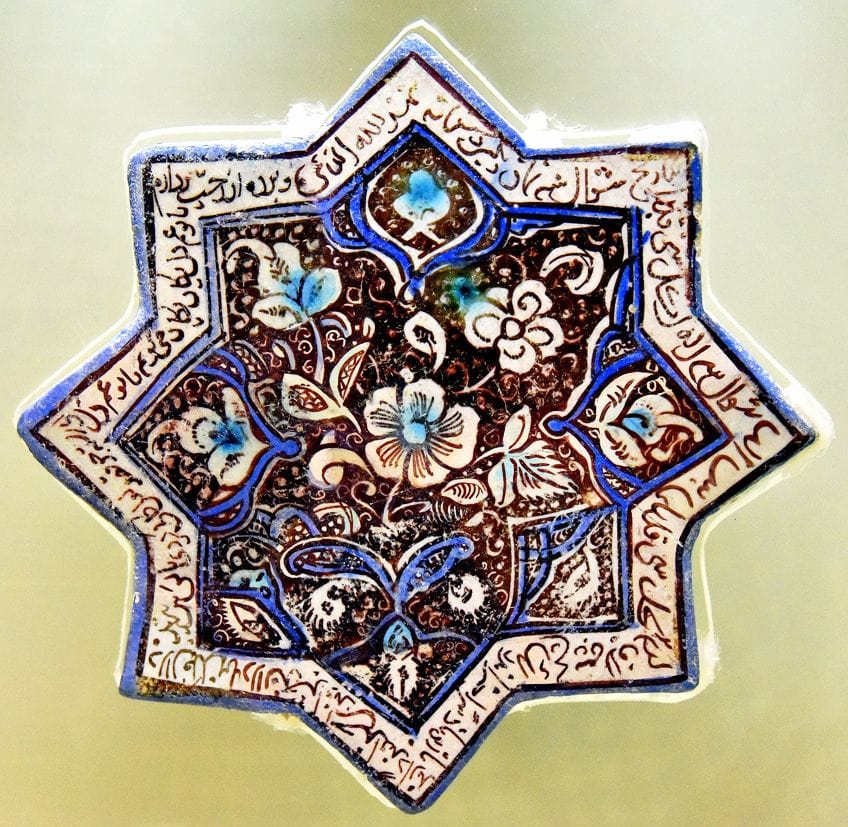 eight-pointed star tile, luster technique, glazed. Ilkhanate period, second half of the 13th century CE. From Kashan, Iran;Osama Shukir Muhammed Amin FRCP(Glasg), CC Past-SA 4.0, via Wikimedia Commons
When an object or building had elaborate decorations, the focus was taken off the bodily object and suggested a deeper world that transcended the material world. This notion is especially emphasized past the infinity motifs utilized in varying degrees. These Islamic motifs open up upward and transform the base materials from which the objects or buildings are made into something more beautiful and meaningful.
Islamic Calligraphy Art
When we take a closer wait at Islamic calligraphy art, there were two dissimilar calligraphic scripts used, namely, the Kufic script and the Naskhi (or Naskh) script. One of the oldest Standard arabic scripts, the Kufic script originates from Kufa, a city in Republic of iraq, from the Nabatean culture. The advent of the Kufic script is horizontal, and the letters have an athwart delineation when written. In other words, there is a stiff verticality that pronounces the letters.
The script's letters are often described as geometric and linear with vertical and horizontal aspects.
There are also several different types of this script, such every bit the floriated Kufic, which has floral-like adornments to the messages; the foursquare Kufic, which was used on bricks or tiles in architectural structures that gave the script a block or foursquare-like advent; the knotted or plaitedKufic, which was used on architectural structures; and the foliated Kufic, which has half-palmettes and "lobed leaves" on the vertical letters. These are simply several examples among many other types of the Kufic script.
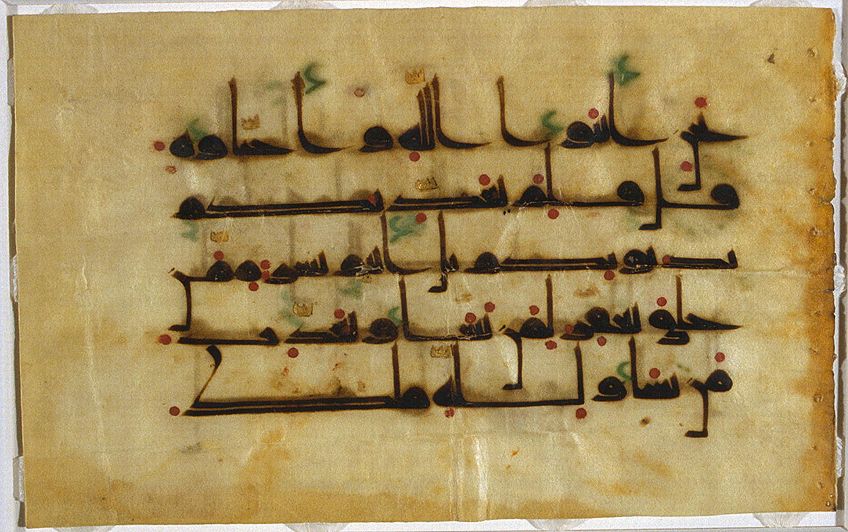 The outset of verse 18 from the fifth chapter of the Qur'an, entitled al-Ma'idah (The Table). The text is executed in a Kufi script at v lines per page in horizontal format. This detail script is differentiated by the upper stroke of the alphabetic character kaf (yard) which slants to the correct before turning to the left. The text is executed in black ink, while red dots indicating vocalisation may have been added afterward. Diacritical marks also appear to have been added subsequently: for case, glottal stops (hamza) are marked in dark-green ink, while duplications of consonants (tashdid) are executed in gilded ink, 10th century; Unknown Calligrapher, Public domain, via Wikimedia Commons
The Kufic script was important in that it was used to copy the Qur'an, but it was also used for ornament purposes on lusterware, glass, coins, compages, and more. Some examples of this include many pages taken from different versions of the Qur'an during the viiith to 9thursday Centuries CE; the Abbassid Qur'an, Persia (late 11th to 12th century CE); and two bowls, 1 with Kufic inscription (9thursday century CE) and the other with Kufic calligraphy (10th century CE), both of which are housed in the Brooklyn Museum. Other examples include the gilded Fatimid armlet (11th century CE), which is inscribed with a well-meaning message.
The Naskhi script, on the other paw, started replacing the Kufic script during the 11th century. Notwithstanding, there are scholars that judge both scripts were utilized centuries before they were given prominence. The Naskhi script is rounder in appearance and generally used for scribing, whereas the Kufic script was used significantly for decorations of diverse kinds.
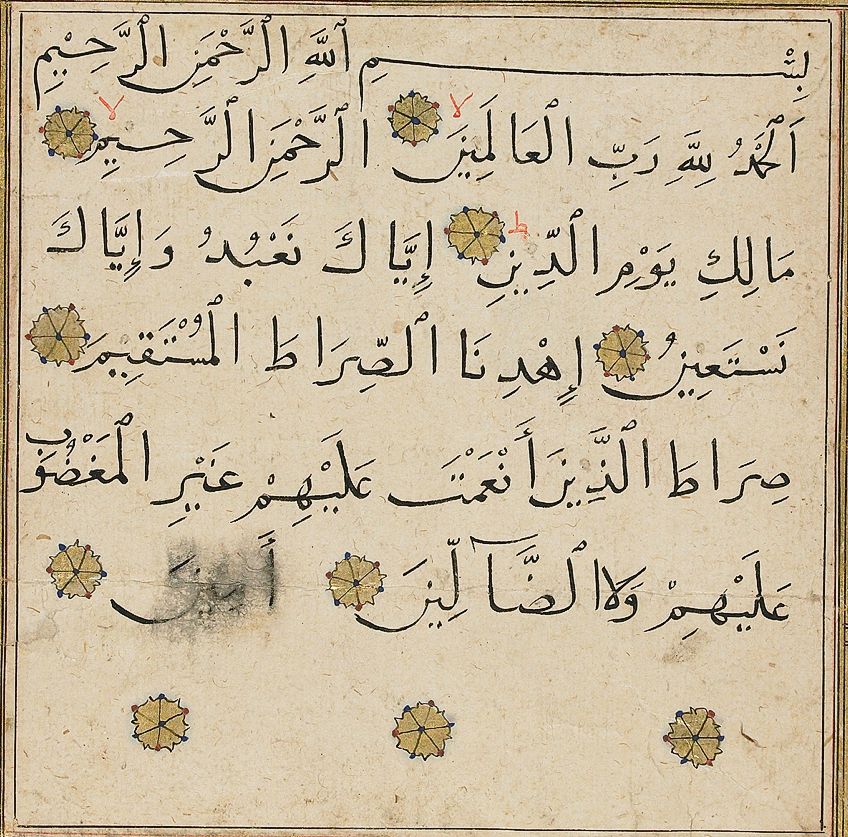 Naskh script: This Qur'anic fragment contains the beginning chapter of the Qur'an entitled al-Fatihah (The Opening). Recited at the very beginning of the Qur'an, this surah proclaims God as Gracious and Merciful, the Primary of the Day of Judgment, and the Leader of the straight path. The illuminated upper and lower panels incorporate a text, outlined in gilded ink to permit the plainly page show through, stating that this surah is the opening of the Holy Book (Fatihat al-Kitab al-'Aziz) and contains seven ayahs revealed in Mecca. The text itself is written in the cursive script called Naskh, and each verse is separated by an ayah marking consisting of a gilt six-petalled rosette with blueish and red dots on its perimeter. Both the script and the illumination are typical of Qur'ans produced in Mamluk Egypt during the 14th and 15th centuries;Al_Fatihah_-_naskh_script.jpg: Unknown Calligrapherderivative work: Cvereb, Public domain, via Wikimedia Commons
The Naskhi script was mostly used to write administrative documents as well as to transcribe various texts, including the Qur'an. Information technology was easier to read because information technology did non have the decorative elements we see from the Kufic script.
An easy fashion to place this script is through the lack of "hooks" or small "lobes" adorning the ends of letters.
Ibn Muqla is known to have invented the Naskhi script, forth with the cursive text called Thuluth and v other scripts called Tawqi', Ruq'ah, Muhaqqaq, and Reyhan. All 6 scripts are referred to as the "6 Pens" and vary in style.
Islamic Architecture
The Islamic architectural mode can be seen in the near important structure for Islam, which is the mosque. The mosque in Arabic is called masjid. Information technology is a religious building for prayer and praise, although it is also used for community purposes like studying, gatherings, or tranquility reflection.
The mosque is an important structure in the Islamic faith and so too became an of import structure inside Islam fine art.
Mosque architecture is believed to accept originated from the beginning mosque, the Quba Mosque, which was Mohammad's home. Information technology was in the style of an Arabian house from the 7thursday century CE, in Medina, which is now Western Kingdom of saudi arabia. The Arabian style had a courtyard, rooms, and columns.
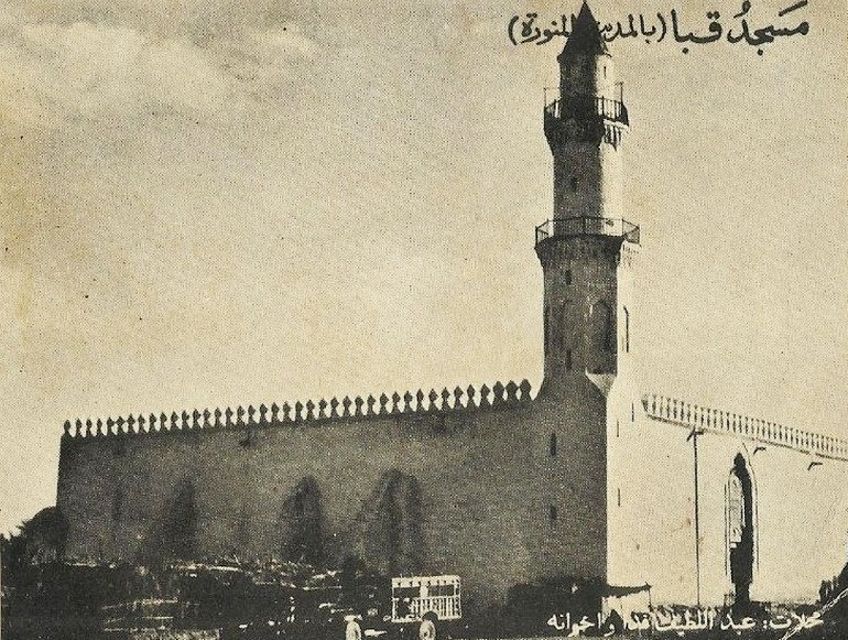 The original Quba Mosque in Medina, built past the prophet Muhammad;Unknown author Unknown author, Public domain, via Wikimedia Eatables
The rooms appeared long in their design and were supported by numerous columns, giving the building its classification equally a hypostyle mosque. The discussion hypostyle originates from the Greek word, which means "nether columns", and this was 1 of the typical styles of mosques for many centuries, a feature common to prayer halls.
There are some overall characteristic features that appear in Mosque architecture, although it is important to understand that Islamic architecture also varied widely due to the vast geographic expansion, regional styles, and the time it occurred in Islamic history.
One such feature is the Sahn, which is the large courtyard. This is an important part of the Mosque's prayer hall because of mandatory prayer omnipresence by all men in the Islam community, pregnant that in that location needs to be enough infinite to business firm anybody. There are fountains in the courtyards to offer hydration and cleansing prior to prayer.
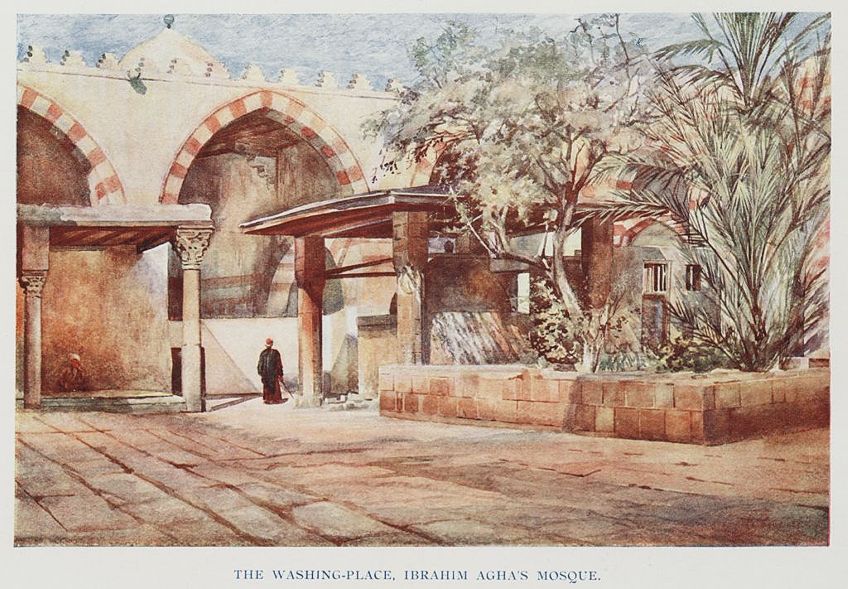 A 1907 painting of the fountain in the interior of Ibrahim Agha'south;Tyrwhitt, Walter S.S., CC By-SA 2.5, via Wikimedia Commons
The Mihrab, also called the qibla wall, is a niche or apse in the wall that points in the direction of Mecca, which is the direction of prayer. The size of the Mihrab varies in different Mosques, but it is usually a smaller, shallower infinite in the wall. An instance includes the Mihrab from the Great Mosque in Córdoba (c. 786 CE).
We will also notice the varying decorations that beautify the Mihrabs. Other examples include the Mosque-Madrasa of Sultan Hasan in Cairo (c. 14th century CE); the Jameh Mosque of Isfahan, with aMihrab every bit a stucco carving of the ruler Uljaytu (14th century); the Rüstem Pasha Mosque in Istanbul with Iznik tiles (xvith century CE); and known among the largest mosques located in India, the Jama Masjid (c. 17thursday century CE), which is in Delhi.
 The facade of the Mihrab in the Great Mosque in Córdoba;José Luis Filpo Cabana, CC BY 3.0, via Wikimedia Commons
Other common features of Mosque architecture include minarets, which are towers attached to the mosques serving different functions. Most chiefly, these are the sites where the call to prayer is performed. These are also continuing examples of the Islam religion, acting as a visual structure that represents the faith and culture.
Minarets have different shapes and styles. Some are spiral-shaped, pencil-shaped, or square-shaped, like we encounter in the Great Mosque of Kairouan (9th century CE). The latter has three different levels that widen every bit they become downwardly.
Another instance is the Minaret of Jam (12th century) in Afghanistan. Standing at over 200 feet tall, it is a circular shape with ii balconies. It depicts various inscriptions, names, and dates, including the Shahada as decorations around it, and is made of brick, stucco, and glazed tile. The minaret appears to be standing lone, however, scholars suggest that information technology was role of the Friday Mosque of Firozkoh, which washed away due to flooding prior to or during the earlier parts of the 13th century CE.
There are too the pointed minarets from the Sultan Ahmed Mosque (likewise referred to equally the "Blue Mosque"), built in the 17th century CE in Istanbul. This mosque has six minarets that are pencil-shaped and fluted, each with balconies.
 1762 view and floorplan of the Blueish Mosque in Istanbul; Anonymous Unknown author, Public domain, via Wikimedia Commons
The minaret from the Al-Azhar Mosque (15thursday century) was located in Cairo, which belonged to Sultan Qaytbay. This was likewise a large funerary circuitous consisting of the mosque, madrasa, and mausoleum. Along with the minaret, this complex is richly decorated within and out and is ane of the best examples of Egyptian Mamluk architecture.
The dome, significant Qubba in Standard arabic, in Mosque compages is some other feature. At that place would often be one dome to a structure, although some would have multiple domes. Domes were significant features for Mosques considering they represented the idea of transcendence or heaven. The inside of the dome would be decorated in rich detail, nigh giving the space a new pregnant beyond the material world.
The Dome of the Rock (7th century CE) in Jerusalem is considered one of the kickoff domes used in Islamic architecture.
The dome is made from forest and was covered in golden plates during the 16th century CE. We too notice the characteristic bulbous domes on the Süleymaniye Mosque (16th century CE), which is an Ottoman imperial mosque, the Taj Mahal (17th century CE) in Bharat, likewise as the Badshahi Mosque (17th century CE) in Lahore, Islamic republic of pakistan.
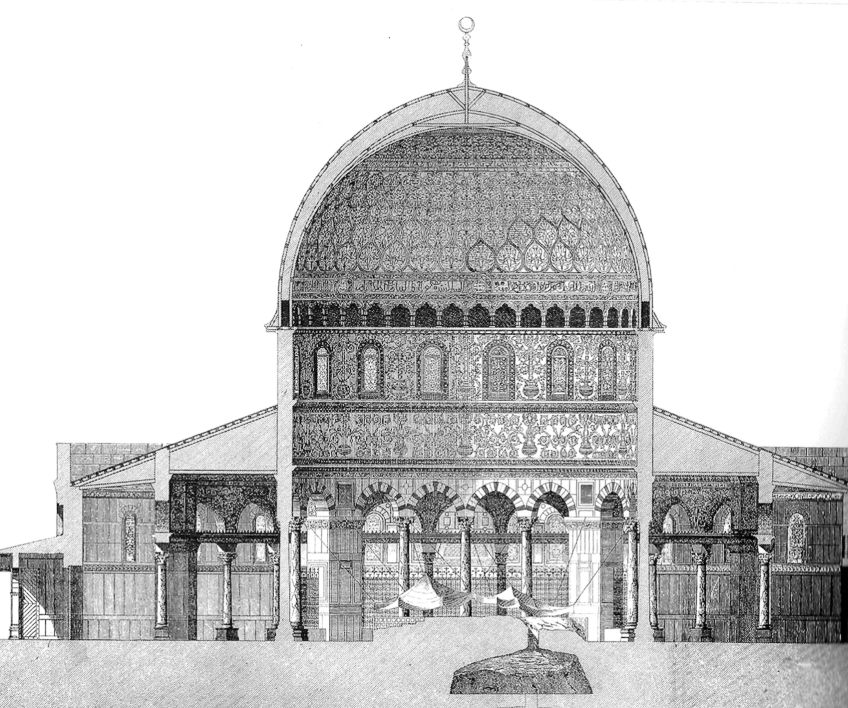 Diagram of the Dome of the Stone, drawn by Viscount De Vogue in 1864;VICOMTE DE Vogue, Public domain, via Wikimedia Eatables
Additionally, the domes included the use of vaults to support the structure inside, such equally the rib vaulting in the Jameh Mosque of Isfahan (xith century) in Iran. The vaulting is described equally "non-radial" in layout, which was a common feature from the East. Some domes and vaults were also decorated with Muqarnas, which is described as resembling "honeycomb" or "stalactites". These are sculpted patterns aslope the ceiling that stand out in varying shapes and sizes.
Nosotros volition also notice columns and arches in Mosque architecture. Columns varied in size, shape, and material. Some of the earlier columns included the Classical style from Mediterranean areas, appearing smoother and fluted. In countries similar India, columns were made from Indian stone and had foursquare, octagonal, and circular shapes.
Arches also appeared like Roman arches and were more often utilized during the 8th to 10 Centuries CE in Islamic architecture.
 Pic from the von Hallwyl family'due south journey through People's democratic republic of algeria and Tunisia, 1889-1890. Caption reads: "Tlemcen. Interior of the Great Mosque.";Past Unknown author, Public Domain, Link
The Islamic arches are described by iv distinguishing shapes. The "horseshoe" shape, also called the "keyhole" shape because of its rounded edges, widens in width near the top of the arch and narrows almost the sides. The "pointed" curvation shape shares similarities to Gothic architecture and the "ogee" shape appears similar the pointed arch, merely it is more stylized; the top curve of the arch is more curvilinear (S-shaped) in design and the top tips encounter from the S-curves. Lastly, the "multifoil" shape appears more "scalloped" in design, fabricated by a combination of "foils" in the biconvex shape.
Other Islamic Art Forms
Below, we briefly talk over some of the other modalities that were vehicles for the broad scope of Islam fine art. Alongside Islam calligraphy, art, and architecture, there was a lot of development in Islamic painting, which took on different formats like miniatures and illuminated manuscripts.
In that location were also Islamic ceramics, pottery, textiles, glasswork, and metalwork.
We volition also see the intricate craftsmanship of the Islamic motifs in other forms like leatherwork, jewelry, carvings from semi-precious stones (also referred to every bit hardstone carvings) and ivory, different pieces of furniture and household items, besides as materials like silk and batik.
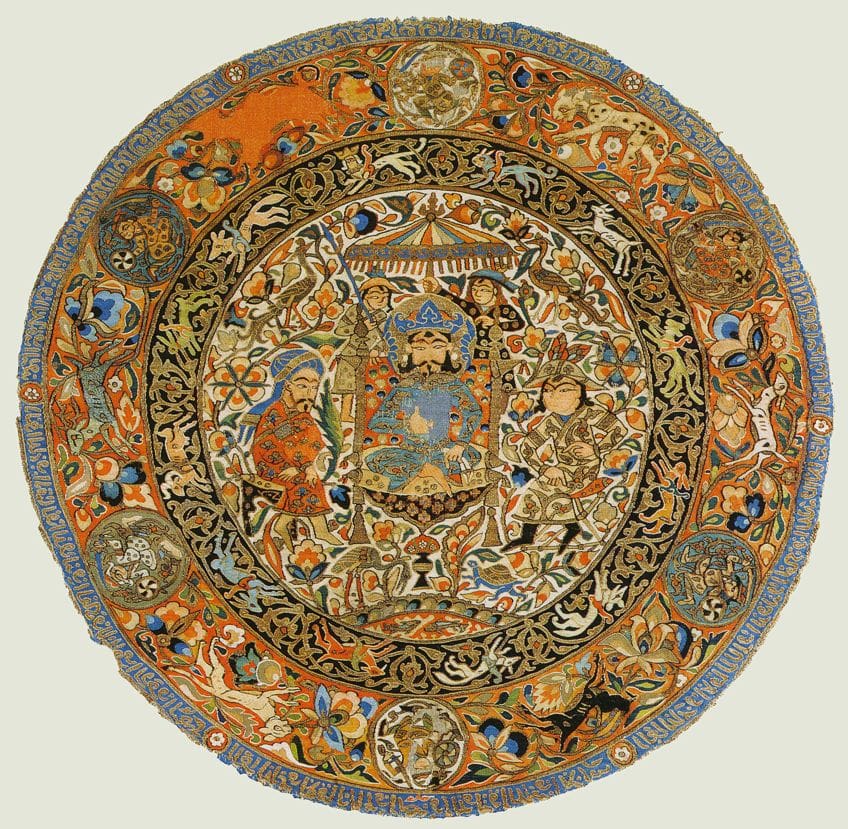 Ilkhanid Medallion, circular piece of silk with Mongol images, Iran or Iraq, early 14th century;David Collection, Public domain, via Wikimedia Commons
Islamic Paintings
Islamic paintings included the more than famous illuminated manuscripts (book painting) as well as miniatures. Volume paintings were common in various regions like Iraq, the Ottoman Empire, Persia, and Syrian arab republic. It is believed that this way originated during the 13th century CE when the Mongols infiltrated the Islamic culture, and equally a result, the Ilkhanid Dynasty is where the offset "Farsi books" started.
Illustrated books were commonly commissioned by the regal courts and aristocrats as they required considerable fiscal investments to make.
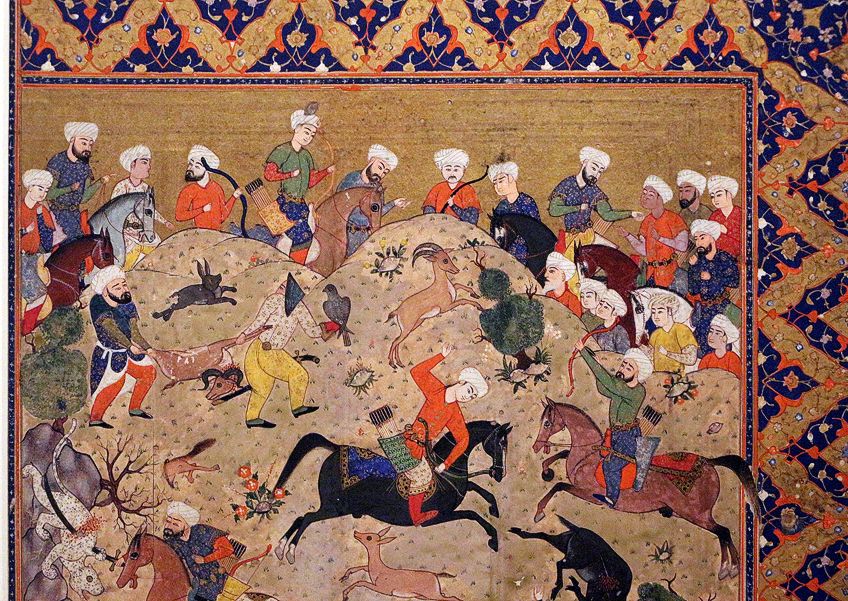 Islamic painting depicting a hunting scene, c. 1550;Sailko, CC Past 3.0, via Wikimedia Commons
Once the book was completed, the Islamic paintings would be done by diverse artists. The subject field would range from battle scenes, landscapes, and portraits. On occasion, paintings would be done from Islamic drawings or sketches that were already done and and then copied over. Various natural pigments were utilized for Islamic paintings, subsequently which they would be gilded and illuminated.
Islamic miniatures also adult aslope illuminated manuscripts, condign a pop form of Islamic painting.
The miniatures consisted of minor paintings washed on paper and were nigh prevalent in the majestic courts, every bit mentioned to a higher place. We will likewise find the common depiction of figural forms and influence from the Byzantine and Chinese eras.
The illustrated books drew extensively from Persian poetry, such as from the Shahnameh, which is an epic verse form by the Persian chosen Ferdowsi. There were other stories that revolved around historical accounts, autobiographical stories, also as war machine stories.
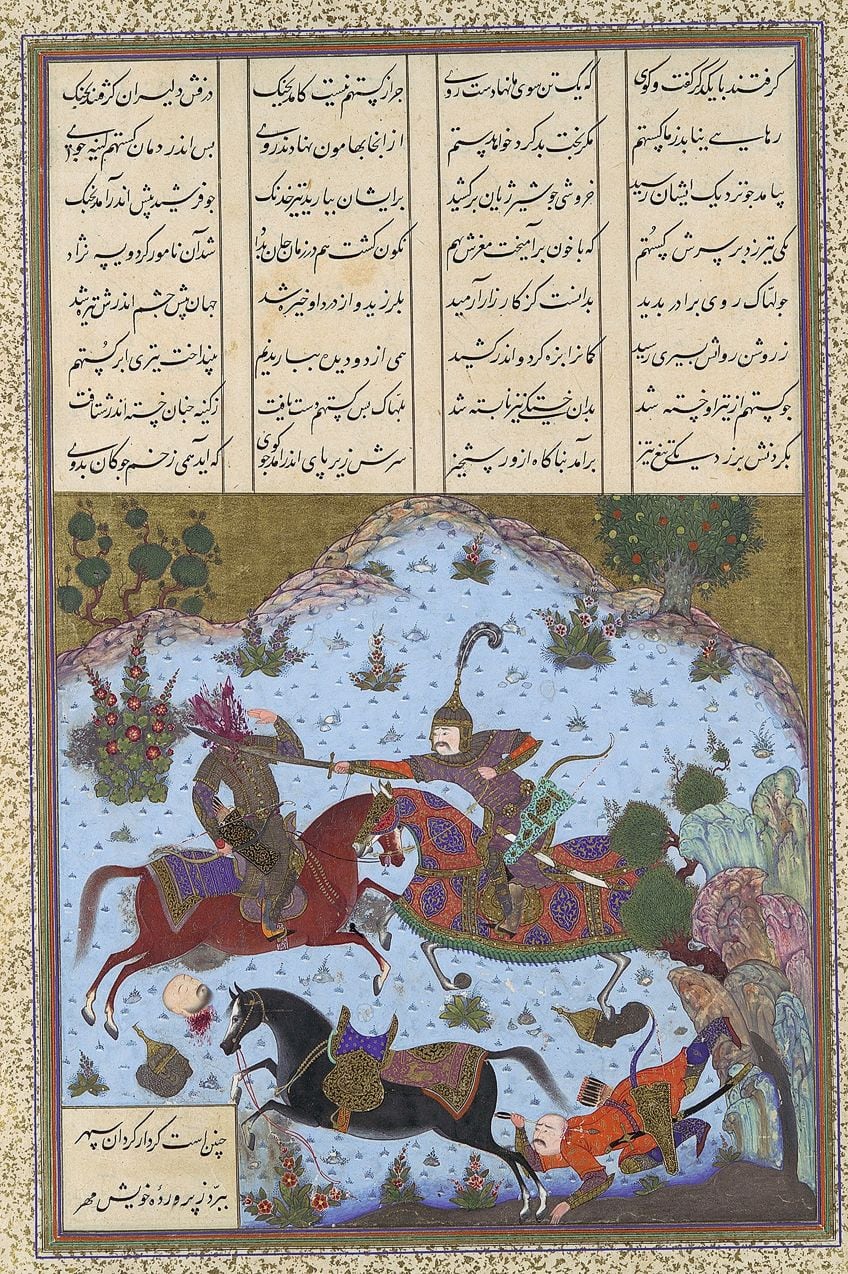 Gustaham Slays Lahhak and Farshidvard (c. 1525-1535), painting attributed to Bashdan Qara;Homaaaa, CC BY-SA 4.0, via Wikimedia Commons
Islamic Ceramics
Islamic ceramic art is important to note here because information technology became i of the most adult forms of Islam art and civilization compared to other cultures. It took on the forms of pottery and tiles, which adorned many of the architectural structures.
The earliest Islamic pottery was unglazed, but i of the earliest glazing techniques was the tin-opacified glazing. Stonepaste was some other technique introduced during the 9th century CE in Iraq.
During the Ottoman rule, Iznik ceramics were a beautiful artform and testament to the Islamic civilisation. Muslim artists drew a lot of influence from Chinese ceramics. However, they were not able to employ porcelain due to lack of availability, and so Muslim artists created another type of pseudo-porcelain, which became known as fritware. Information technology was made from glassy frit, basis quartz crystal, and potter's dirt.
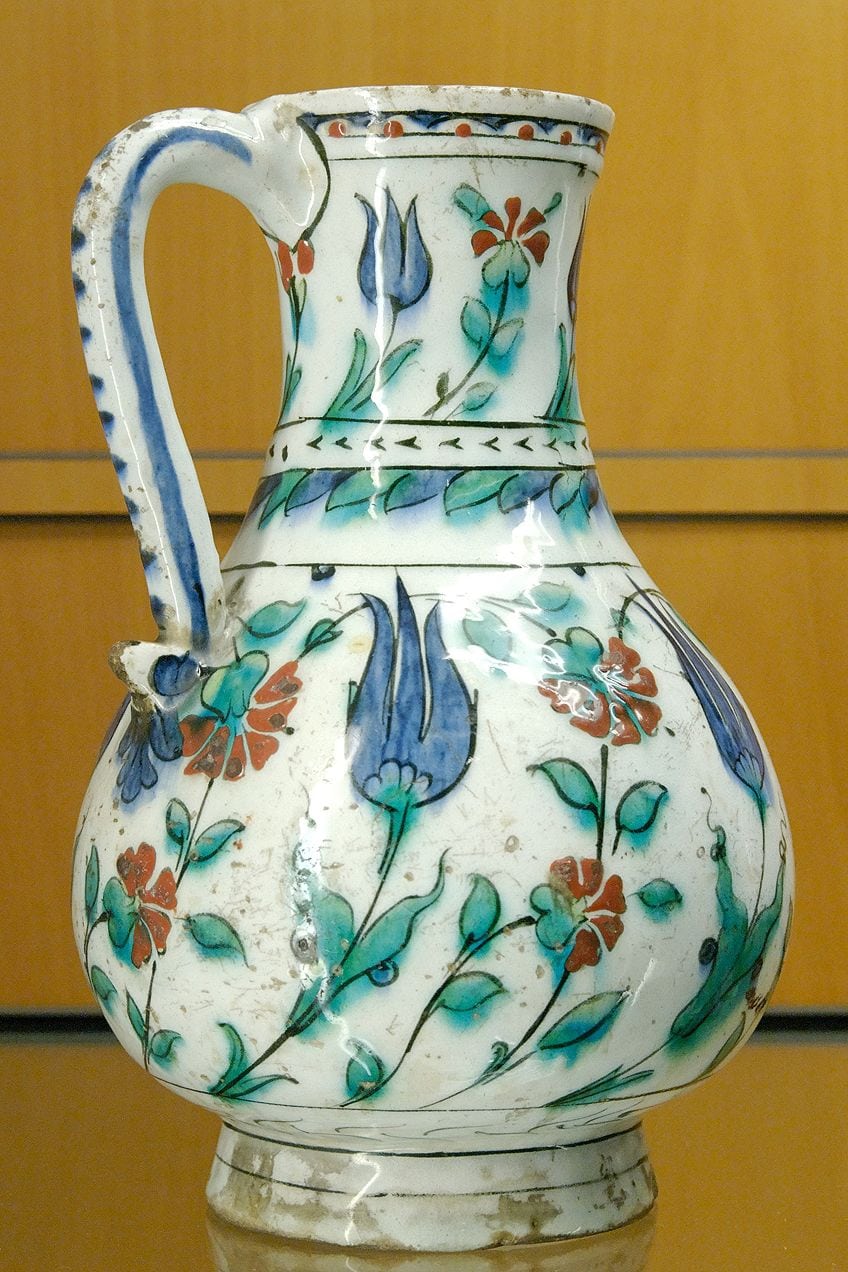 Jug with tulips and carnations. Composite trunk with underglaze engobe decoration, Iznik, Ottoman Turkey, c. 1590;Museum of Fine Arts of Lyon, CC BY two.5, via Wikimedia Commons
An example includes the Iznik Ewer (c. xvith century CE), which shows the traditional blueish and white color scheme widely applied to ceramics with additions of other colors like greens and reds. We as well notice decorative black-painted bands around parts of the ewer to create a sense of separation. The ewer has a transparent glaze over all the colors. The shape of this ewer has a rounded, bulbous trunk, a narrow neck, and an oval-like handle.
Fritware is also compared to Islamic metal jugs from the 15th and 16th centuries CE equally well as Chinese jugs from the Ming Menstruum (1368 to 1644).
Islamic Glasswork
Islamic glasswork became ane of the most highly regarded forms of glasswork and was even exported to Prc and Europe. It also retained much of the Roman drinking glass production techniques and developed it in unique new means. In that location have been numerous types and styles of Islamic glasswork and hundreds of artists since around the eightthursday century CE.
This form of Islam art provided new ways of adorning mosques and buildings, and is often described equally "sophisticated" and "advanced" compared to other regions that produced drinking glass. Islamic glasswork consisted of either glassblowing or glass cutting.
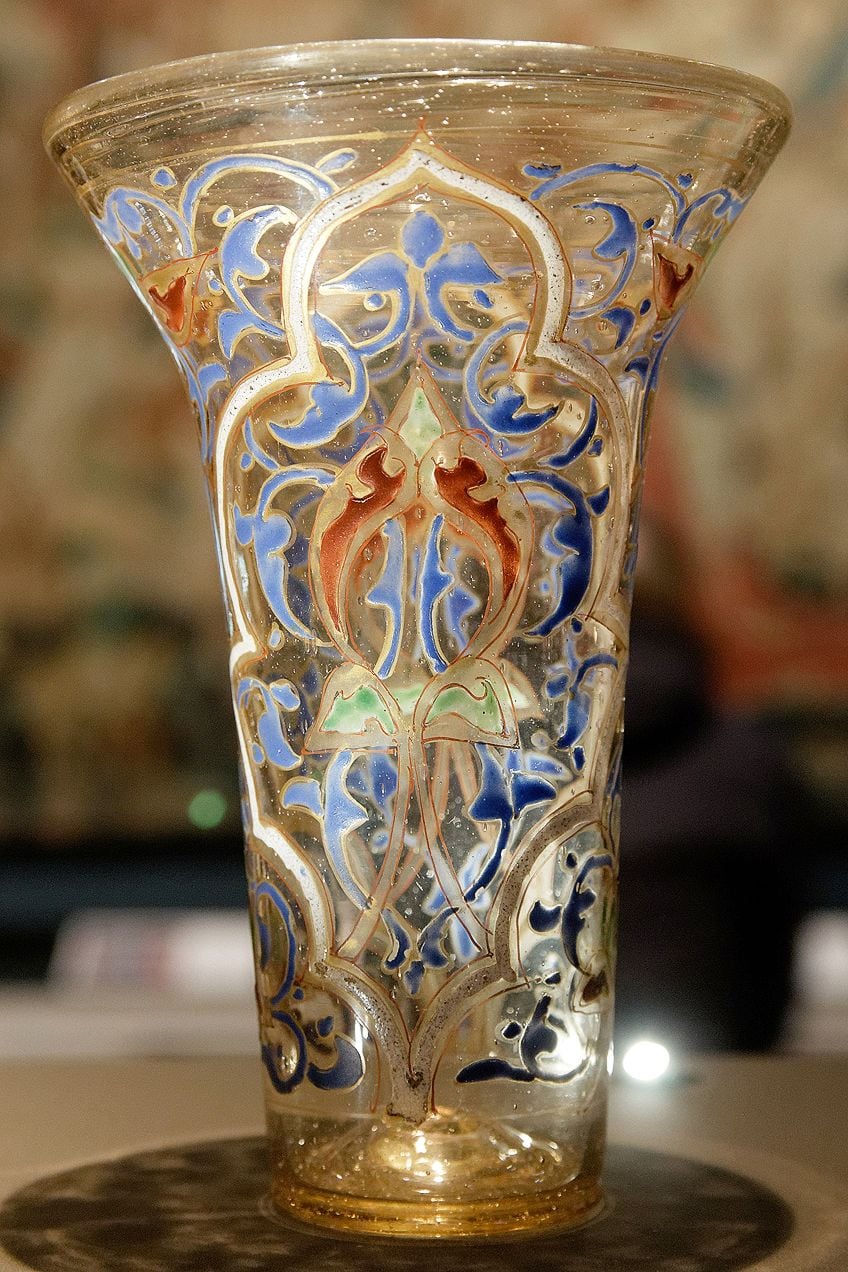 The Luck of Edenhall, a beaker made in Egypt or Syrian arab republic, c. 1350;Victoria and Albert Museum, CC By 2.5, via Wikimedia Commons
An example is theLuck of Edenhall (14th century CE), which is a chalice made from enameled drinking glass. It depicts Arabesque shapes in varying colors ranging between blue, red, green, and white. It also has golden touches along the edges and a narrower body that widens at the top.
Some other example includes the Mosque Lamp (c. 1329 to 1335), which was made for Amir Qawsun. It is made from Egyptian enameled drinking glass. This is also 1 of the hundreds of other mosque lamps that were made from glass. Lamps were important light sources in mosques and were e'er utilized. They typically have similar shapes, being a more "bulbous" trunk and a narrower cervix.
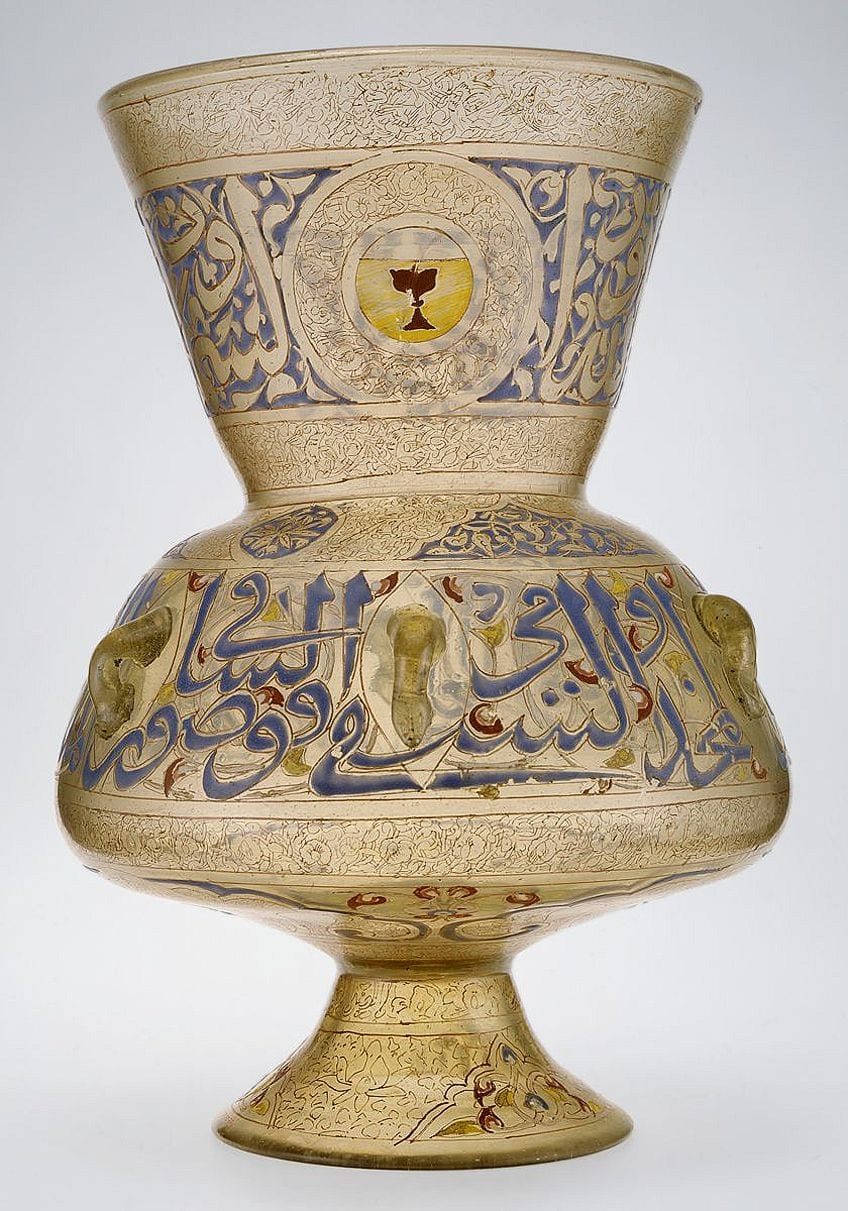 Mosque Lamp of Amir Qawsun, c. 1329 to 1335;The Metropolitan Museum, CC0, via Wikimedia Commons
Islamic Metalwork
Islamic metalwork was primarily made from steel, contumely, or bronze. The types of items made varied from common household items of more primal and functional purposes to other items utilized for luxury purposes, which would take been produced for the court. The range of items included bowls, buckets, ewers, incense burners, braziers, candle holders, lamp stands, plates, and more than.
Items would often be made from silver, which indicated a higher status and was influenced past the before Roman and Byzantine eras. Common items would be made from brass.
Examples of these silver items include two silver plates made in Constantinople. They are titled Plate with David Anointed by Samuel (629 to 630 CE) and Plate with David Slaying a Lion (629 to 630). These depict biblical scenes and were probably created for display at banquets. These Islamic art pieces are examples of items that were used to showcase higher status and wealth.
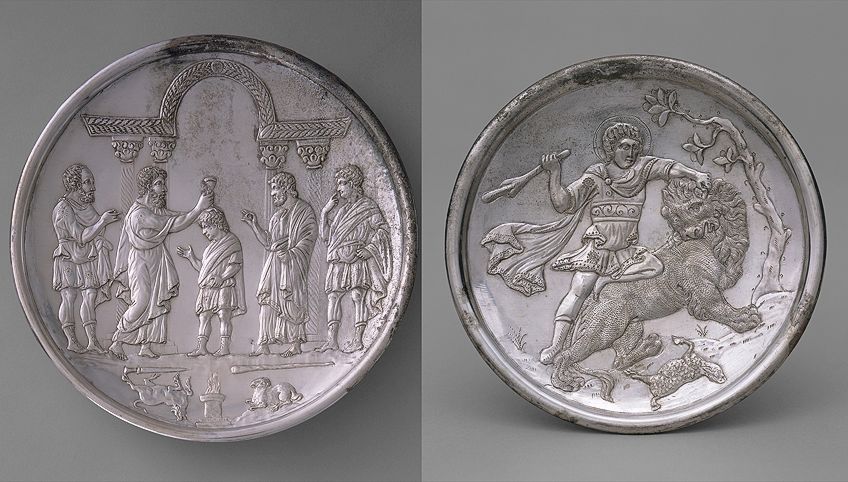 LEFT: Plate with David Anointed by Samuel, 629-630;Metropolitan Museum of Art, CC0, via Wikimedia Commons | RIGHT: Plate with David Slaying a King of beasts, 629-630; Metropolitan Museum of Art, CC0, via Wikimedia Eatables
Islamic metalwork items would also be elaborately decorated, and some would take inlays of aureate and silver. Such an example is the Baptistère de Saint Louis (1320 to 1340), which is a basin made of hammered brass with inlays of black niello, gold, and silver. This basin was made during the Mamluk period by the creative person Muhammad ibn al-Zayn. The higher up basin depicts inner and outer friezes of diverse figural and leafage forms, with notable riders on horses who announced to exist in the process of hunting while other figures are standing without accompanying horses.
Other metalwork items would accept an array of unlike subject matter, ranging between leafage, animals, Zodiac signs, and the feature calligraphy and Arabesque patterns typical of Islamic art.
Other items, such as the 8thcentury CE Brazier, depicted figural shapes like women, satyrs, and birds – subject field matter of a Dionysiac nature. This Brazier was the holding of the wealthy keen-grandson of 'Uthman ibn 'Afan, the third ruling Caliph.
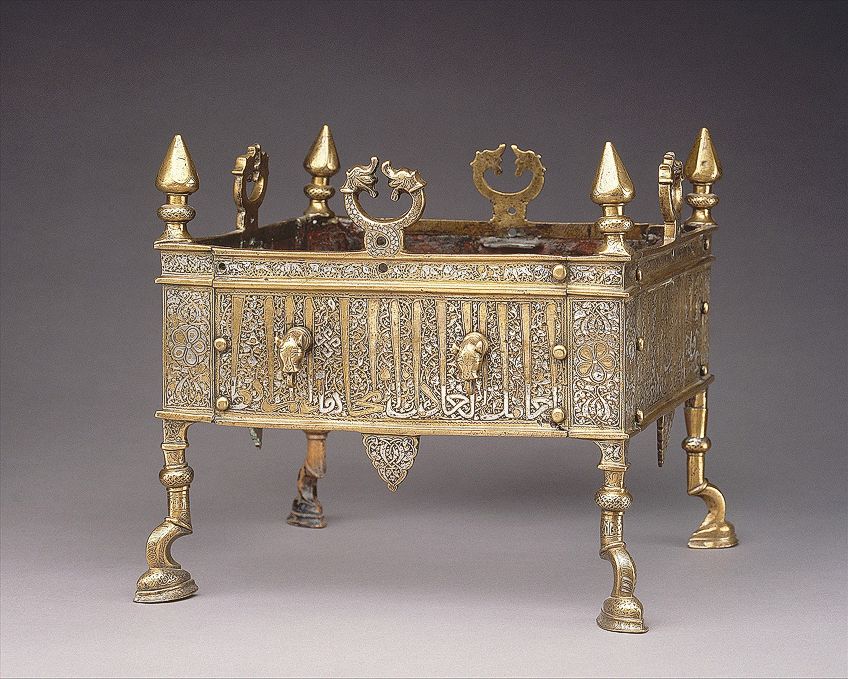 Brazier of Sultan al-Malik al-Muzaffar Shams al-Din Yusuf ibn 'Umar, the second half of the 13th century; Metropolitan Museum of Art, CC0, via Wikimedia Commons
Another instance includes the Lid of an Incense Burner (eightth century CE), which was excavated in Jordan at Umm al-Walid. Information technology is cast from bronze with piercings and engravings. The patterns are formed from bands that run diagonally, making square shapes with open up motifs inside these shapes.
Other household items include diverse ewers and beakers, such every bit the argent Ewer with Dancing Females Within Arcades (half-dozenth to seventh century CE). Here, we come across various Dionysiac elements, particularly the female effigy and various animals with festivity-related objects surrounding her. The ewer itself is ornamental in nature and would have served the purpose of a vessel for wine for festivals or religious occasions. This vessel is from the Sasanian menses and originated in Iran.
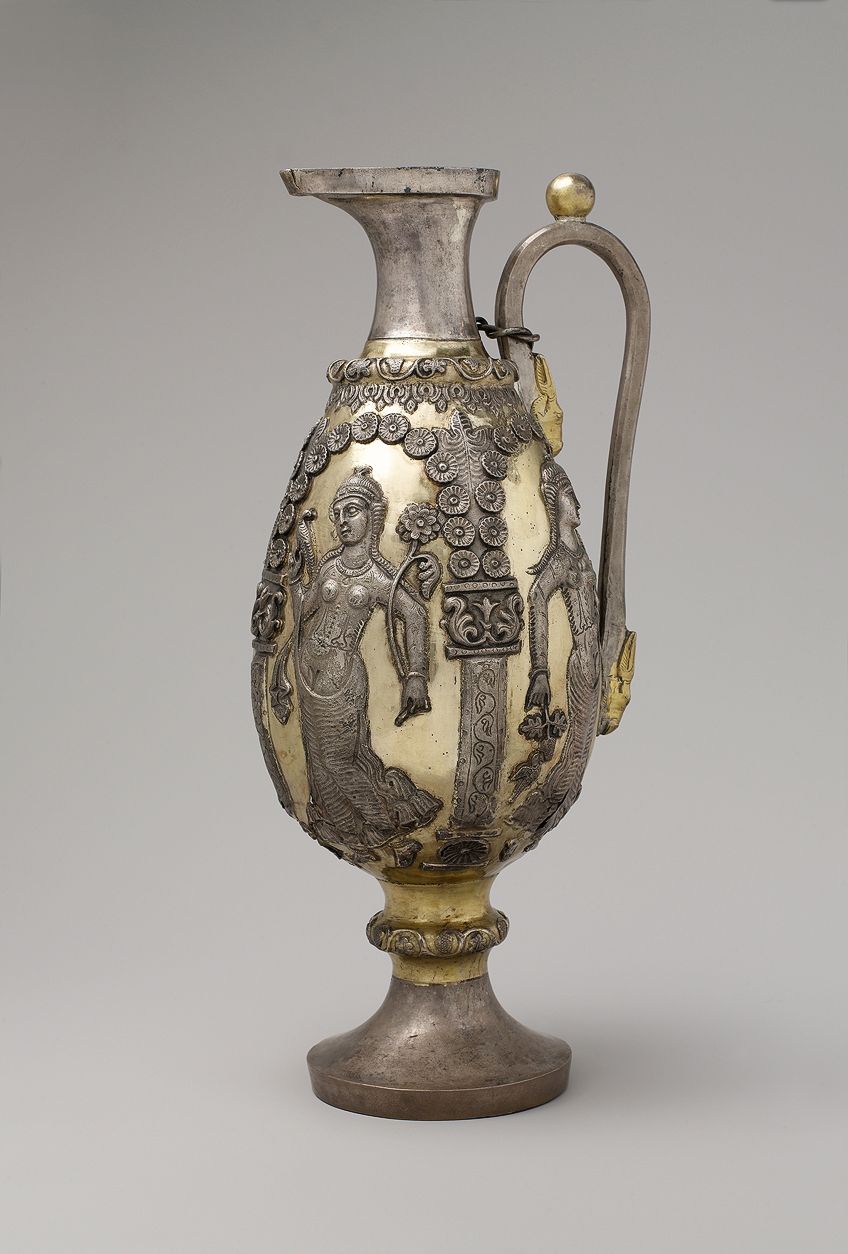 Ewer with dancing females within arcades, c. 6th–7th century AD;Metropolitan Museum of Art, CC0, via Wikimedia Commons
Bucket with a Hunting Scene (half dozenth century CE) is made from brass and depicts animals in the act of hunting. In that location is an inscription in Greek on this bucket, which would take been used for domestic purposes similar bathing. The inscription reads, "Employ this in expert health, primary, for many good years happily". The bucket was fabricated in the Eastern Mediterranean.
Similarly, some other functional object, this ewer (cast from bronze in the 9th century CE) depicts delicate ornamental foliate curl shapes on the bulbous body, reminiscent of the Sasanian period. This vessel is believed to have been made either in Iran or Iraq.
 Ewer inscribed with name and titles of Abu Mansur Izz al-Amir al-Bakhtiyar ibn Muizz al-Dawla, Buyid menses, Iran, 3rd quarter of tenth century AD;Daderot, CC0, via Wikimedia Eatables
Some items were also signed by the artist, such as the Ewer, Signed by Ibn Yazid (c. 688/689 or 783/784 or 882/883). This is cast from a copper blend and fabricated in Iraq. The inscription is noticeable along the rim of the vessel, written in Arabic in the Kufic script. Information technology reads:
"Blessings to he who fashioned information technology, Ibn Yazid, function of what was made at Basra in the yr sixty-nine".
The vessel'southward handle is highly decorative and ascribed to the belatedly-Sasanian period. It has an oval-like or pear-shaped torso, a narrow neck that flares out into the opening, and a base of operations that narrows as it becomes the body. The patterns are also reminiscent of the Byzantine style; we observe the calorie-free vertical bands on the main part of the vessel's body.
Islamic Art: From the Past to the Nowadays
Traditional Islamic art started to develop over time with more influence from European styles, which is estimated to have occurred during the 18th century CE. However, Islamic art is not but housed in mosques and illuminated manuscripts, but it is also live and well in our contemporary culture.
Muslim artists now produce Islamic art with the aim to connect the by to the nowadays and keep the veneration of the Islamic organized religion and God alive. We see this in many gimmicky exhibitions housing Islamic paintings from the Middle East. An case is from the Islamic Art Now: Contemporary Art of the Middle East exhibition at the LACMA art museum in the U.s.a.. It has been i of the biggest exhibitions showcasing the works of hundreds of Heart E artists and their perspectives.
Islamic art has been around for centuries and is as vast in its manner and modalities as it is in the regions it developed in. We can almost say that it has been all around the world and come round full circle – it ever returns to what is near valued, and that is the Islamic way of life, the path to God, and living in laurels and accord to what is right.
Islamic art is a testament to the deeper aspects of the Islamic culture, and Muslim artists have left the world with an assortment of examples, whether information technology is Islamic drawing, calligraphy, painting, diverse household objects, or architecture, these all express deeper truths and values.
Often Asked Questions
What Is Islamic Fine art?
Islamic art is the term used to designate the arts from the Islamic world that originated during the viith century CE, although the term was first used during the 19th century CE. It describes the fine art, architecture, and various other forms of arts and crafts from the Islamic culture that proficient the Islamic religion. It is also used to designate art forms unrelated to the Islamic religion, just that still comes from the Islamic culture.
What Are the Characteristics of Islamic Art?
Some of the primary characteristics of Islamic fine art include the veneration of the holy text chosen the Qur'an and the letters from the Prophet Mohammad. This is a pregnant influencing factor in what collection Muslim artists to produce artwork, although it was non the sole contributing cistron. Other characteristics include the dominant geometric shapes used equally decorations, called Arabesques. Islamic paintings would oft not draw figural elements like humans and animals, and calligraphy was also a large part of Islamic art and seen widely equally a decorative reminder of the Islamic religion.
When Did Islamic Fine art Occur?
Islamic art is usually viewed in three chronological divisions. These provide an easier understanding not merely of historical accounts but also of how the Islamic Globe evolved over time, artistically and culturally. The chronological order is as follows: the Early Period, which occurred from around 640 to 900 CE; the Medieval period, which occurred from effectually 900 to 1517 CE; and the final, or Subsequently flow, which occurred from around 1517 to 1924 CE.
Source: https://artincontext.org/islamic-art/
0 Response to "What Impact Did Islamic Religion Have on Art and Architecture"
Post a Comment